Eduqas · GCSE · English Language
Present information and ideas: selecting and organising information and ideas effectively and persuasively for prepared spoken presentations; planning effectively for different purposes and audiences; making presentations and speeches
This guide focuses on the WJEC Eduqas Spoken Language endorsement (AO7, AO8, AO9). It covers how to plan, structure, and deliver a formal presentation, as well as how to use Standard English and respond to questions effectively to achieve a Distinction.
- 5 min read
- 3 worked examples
- 5 practice questions
- 8 key terms
Study Notes
Overview
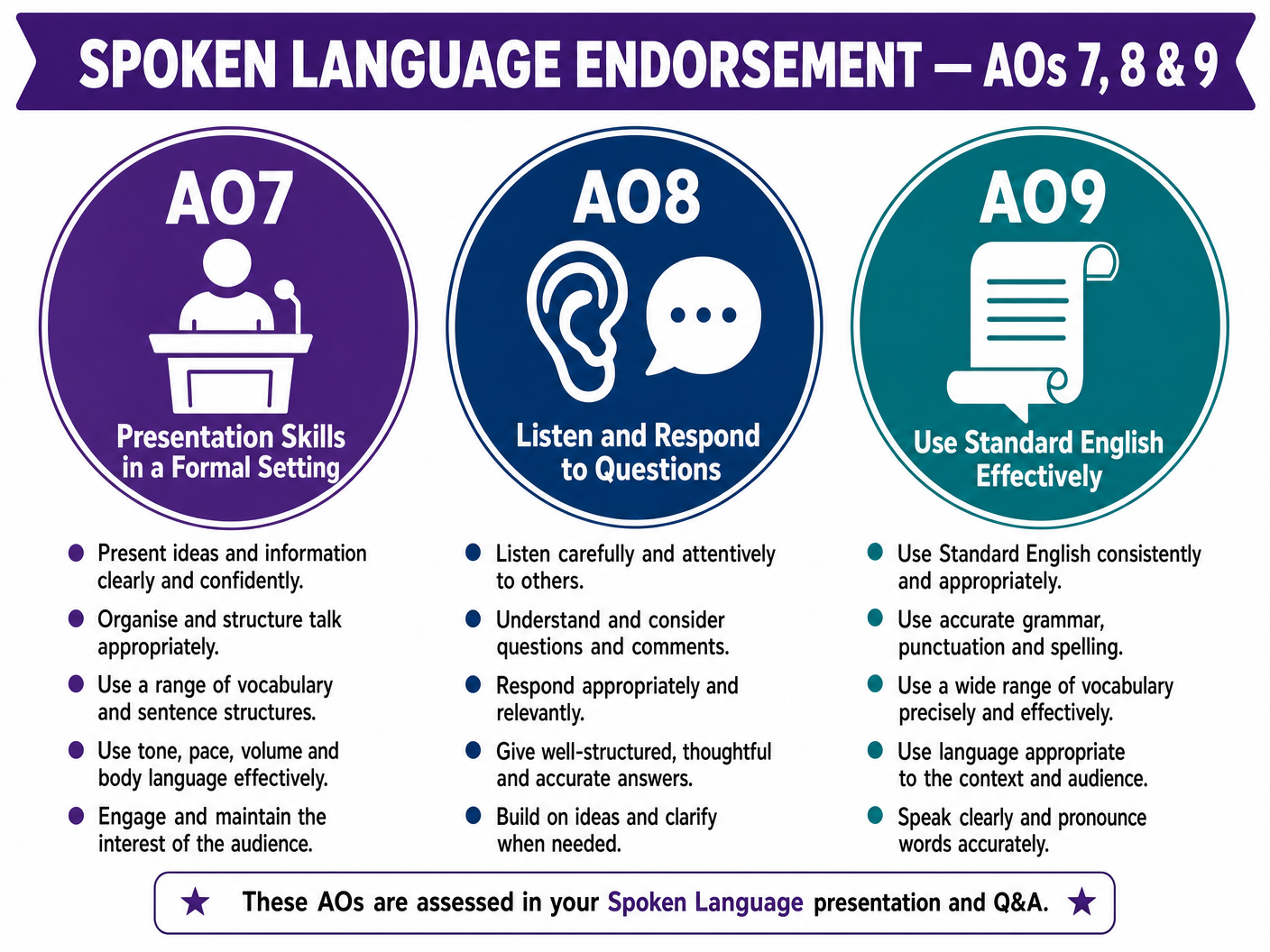
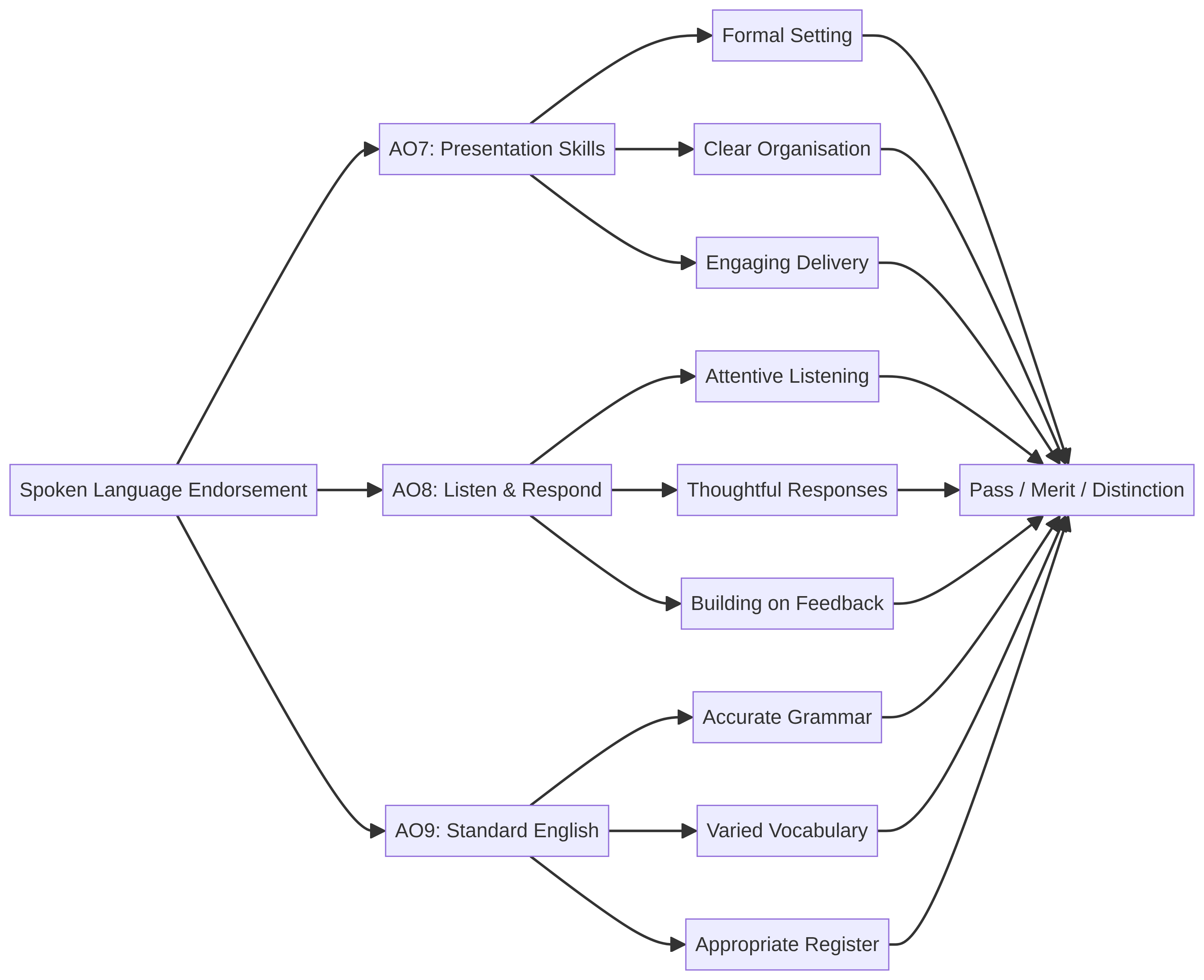
The Spoken Language endorsement is a mandatory component of your GCSE English Language qualification. While it doesn't contribute numerically to your final 9-1 grade, it is awarded as a separate grade (Pass, Merit, or Distinction) on your certificate. Universities and employers look for this as evidence of your communication skills. You are assessed on three specific Assessment Objectives: AO7 (presenting in a formal setting), AO8 (listening and responding to questions), and AO9 (using Standard English).
Listen to our 10-minute podcast for a deep dive into examiner expectations and common pitfalls!
The Assessment Objectives
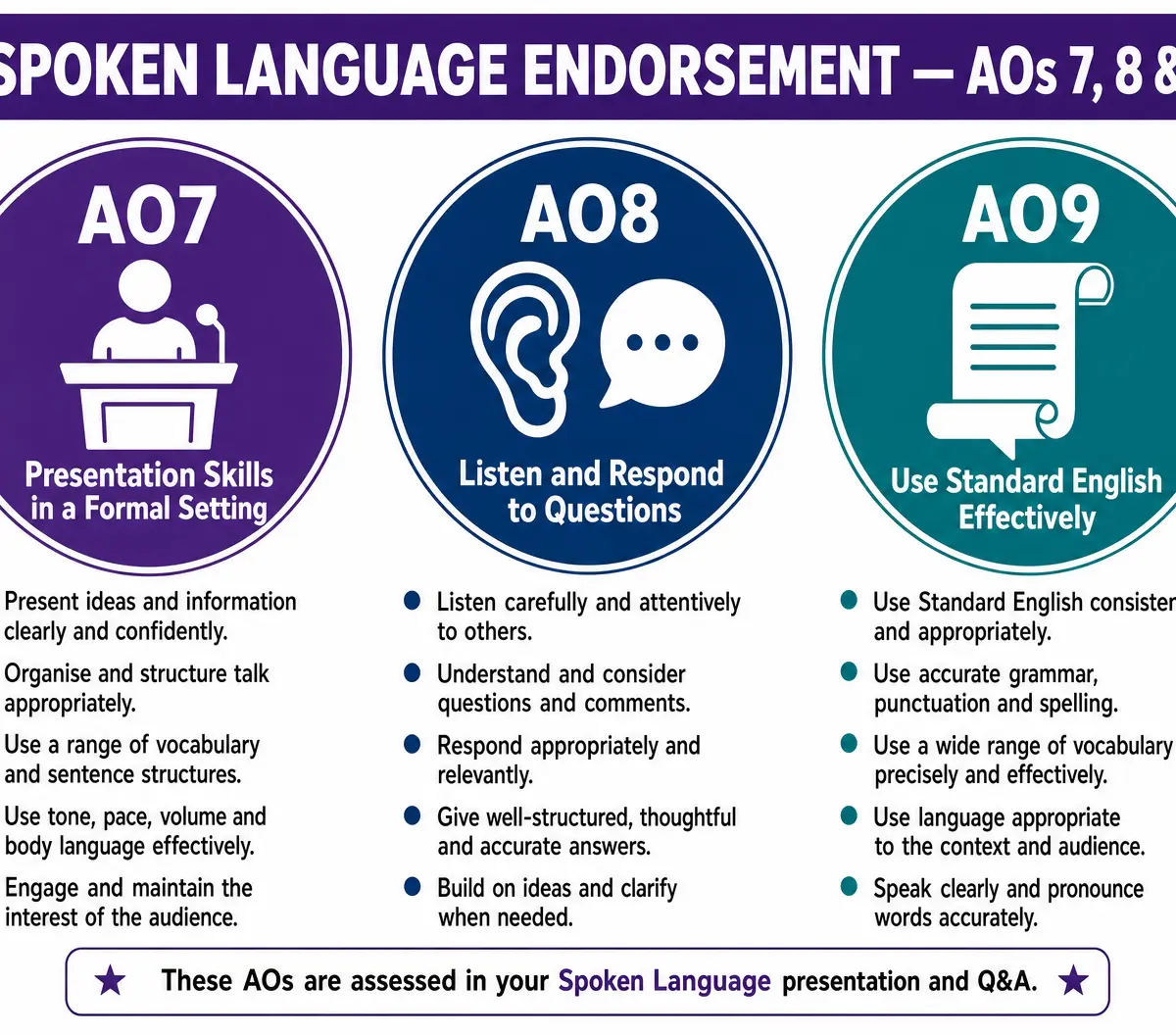
AO7: Presentation Skills in a Formal Setting
This objective requires you to communicate ideas effectively to an audience. A 'formal setting' means you should treat the presentation as a professional address, even if you are only speaking to your teacher or a small group of peers. You need to structure your talk logically, use engaging vocabulary, and maintain appropriate eye contact and body language.
AO8: Listen and Respond to Questions
After your presentation, you will have a Q&A session. This is where AO8 is assessed. Examiners are looking for your ability to listen carefully, process the question, and give a thoughtful, structured response. Simply saying 'I don't know' or giving a one-word answer will severely limit your marks here.
AO9: Use Spoken Standard English Effectively
Throughout both the presentation and the Q&A, you must use Standard English. This means avoiding slang, colloquialisms, and non-standard grammar (e.g., using 'we were' instead of 'we was'). You don't need to sound robotic, but your language must be precise and appropriate for a formal context.
Planning Your Presentation

Choosing a Topic
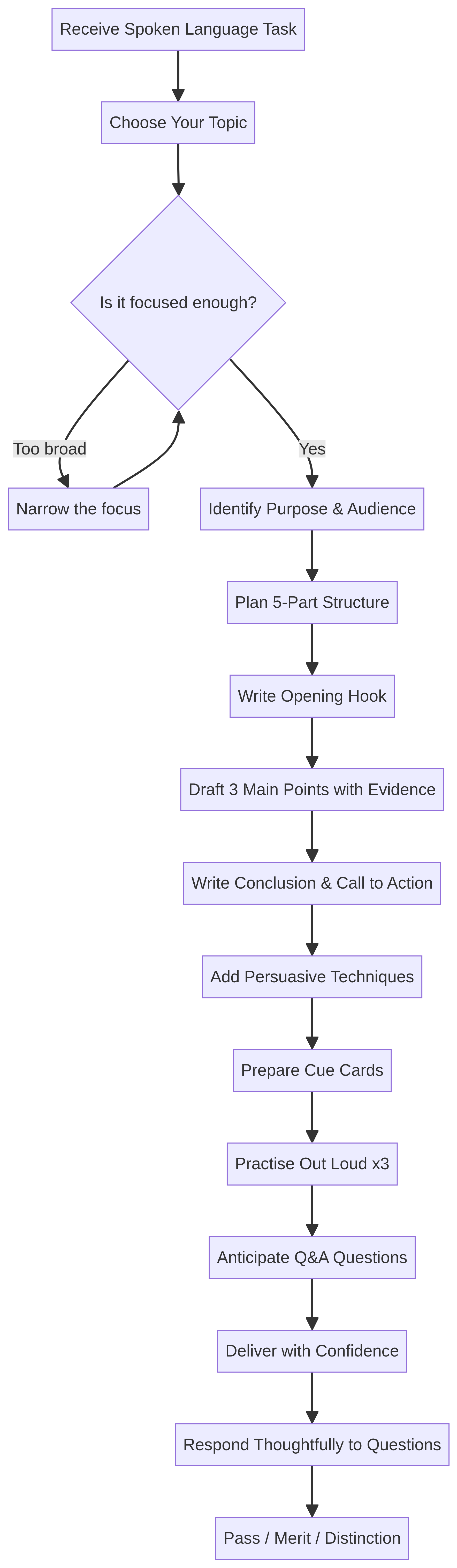
Select a topic you are genuinely interested in, but ensure it is focused enough to cover in 5-10 minutes. Broad topics like 'Climate Change' are too vague. Instead, narrow it down to something arguable, like 'Why the UK must ban all single-use plastics by 2030'. Your presentation should have a clear purpose: to inform, persuade, argue, or advise.
The 5-Part Structure
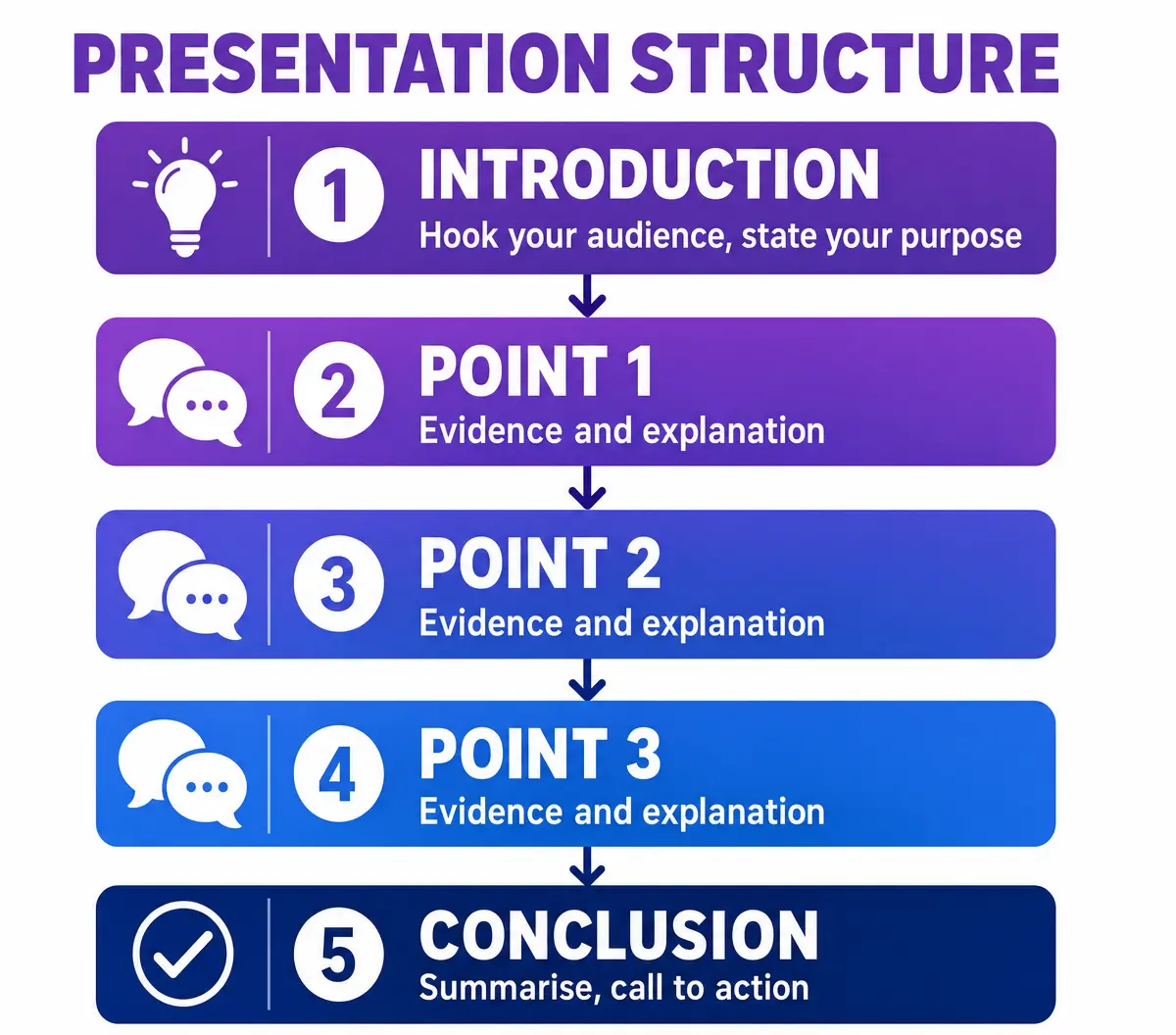
A successful presentation needs a clear structure to guide the listener:
- The Hook (Introduction): Start with a shocking statistic, a rhetorical question, or a bold statement to grab attention.
- Point 1: Your strongest argument, backed by evidence.
- Point 2: Your second argument, perhaps addressing a different aspect of the topic.
- Point 3 (Counter-argument): Acknowledge the opposing view and rebut it. This shows sophisticated thinking.
- The Call to Action (Conclusion): Summarise your main points and leave the audience with a final, powerful thought or instruction.
Using Persuasive Techniques (AFOREST)
To achieve a Merit or Distinction, you must use language deliberately to influence your audience. Use the AFOREST techniques:
- Alliteration: 'We need practical, purposeful progress.'
- Facts: '70% of the world's surface is covered by oceans.'
- Opinions (presented as facts): 'It is undeniable that this policy has failed.'
- Rhetorical Questions: 'Can we really afford to ignore this crisis?'
- Emotive Language: 'The devastating impact on local communities...'
- Statistics: 'Over 2 million people are affected daily.'
- Three (Rule of): 'We must act now, act decisively, and act together.'
Delivery and Q&A Strategy
Delivery Techniques
- Cue Cards, Not Scripts: Never read from a full script. It kills your eye contact and makes your voice monotone. Use bullet points on cue cards to prompt you.
- Pace and Pause: Speak slower than you think you need to. Use pauses for dramatic effect, especially after a rhetorical question.
- Signposting: Use discourse markers ('Firstly', 'However', 'In contrast') to help your audience follow your argument.
Nailing the Q&A (AO8)
Anticipate what your audience might ask and prepare answers. If you get a difficult question, use a bridging phrase like, 'That's a really interesting point. While I haven't researched that specific statistic, my understanding is...' This shows you are listening and responding thoughtfully, even if you don't have a perfect answer.
Visual Resources
4 diagrams and illustrations
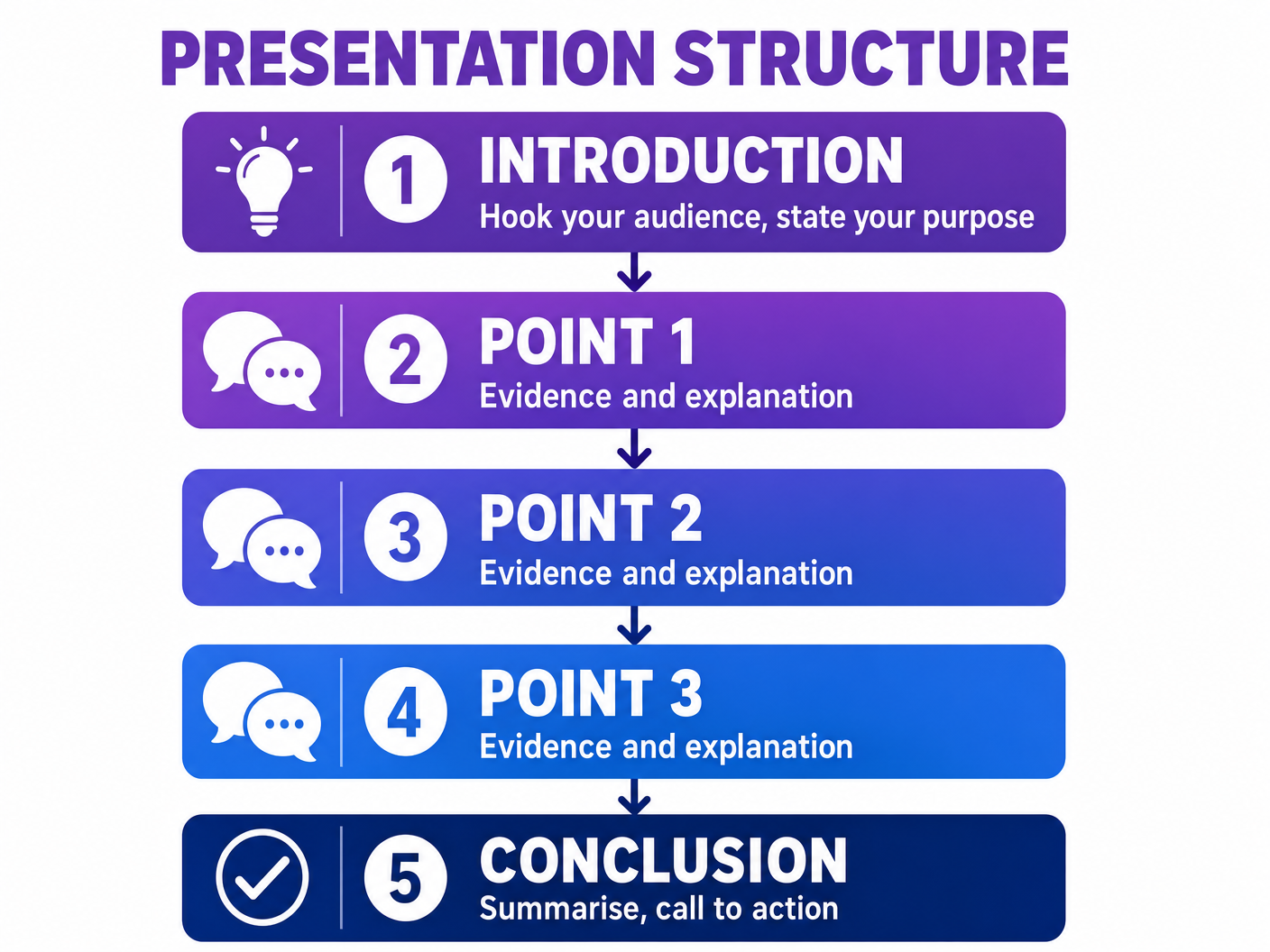
Interactive Diagrams
2 interactive diagrams to visualise key concepts
Conceptual Flow Outline
Step-by-step approach to preparing a Spoken Presentation
Conceptual Flow Outline
How the three Assessment Objectives map to your final grade
Worked Examples
3 worked examples — open one to explore the question and available guidance.
Practice Questions
Test your understanding — click to reveal model answers
Draft an opening 'hook' for a presentation arguing that social media does more harm than good.
Hint: Use a shocking statistic or a direct rhetorical question to the audience.
Identify the non-Standard English in this sentence and rewrite it correctly: 'When we was looking at the evidence, it was obvious that they didn't do nothing to help.'
Hint: Look for incorrect verb agreements and double negatives.
During your Q&A, a student asks: 'But isn't it true that social media helps people find communities they wouldn't otherwise have?' Write a Distinction-level response.
Hint: Acknowledge the validity of their point before bringing the argument back to your main thesis (that the harm outweighs the good).
Write a concluding paragraph for a presentation about the importance of voting, using the Rule of Three and a Call to Action.
Hint: Summarise your main point, use three powerful words/phrases in a row, and tell the audience exactly what they need to do.
How can you use discourse markers to improve the structure of a presentation? Give three examples of markers you could use.
Hint: Think about words that signal a new point, a contrasting point, or a conclusion.